


Down to the nitty gritty - the CCC decision
First of all a hydro outage at my house yesterday, rewiring the panel, and the need for a couple of days off today and tomorrow may mean sporadic posts.
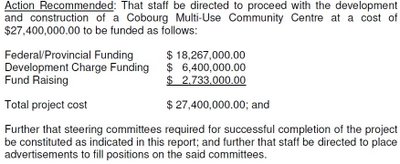 OK here it is: the Community Centre project and it's up for the first real vote on Monday. A thick memo lays out all the details, and the bottom line is that this project will be built without hitting the taxpayers for an extra dime. But you say what about the operating costs? They're in the report but obviously based on best estimates from the Staff. Without a breakdown of the revenues one cannot argue the figures but the report says that total revenues from all three rinks and the revamped Memorial Centre will net a combined loss of $318K. The current loss for two rinks is $126K. So the real operating cost to the taxpayer of Cobourg will be about 1% increase in taxes to pay for the Community Centre which will be built without a tax impact. Look at it in the real world and without bias and it appears to be a good deal.
The devil is in the details and those are to be worked out by three steering committees: fundraising, building and operating. But the absolute bottom line is that $2,733,00 has to be raised from the public - 10% so joe public show your stuff if you want this place pay up if not be vocal in your opposition.
The Corcoran affair has taken a life of its own. Started in an online publication, travelled to the National Post and then carried by the local paper, now it has travelled back into cyberspace where some hardline views are being expressed. But for an depth reasoning of the way Mr Corcoran has approached this issue, and he says the problem is systemic in the parish - that of an unaccepting congregation against changes being implemented by a Parish Priest one should read his blog here. Here is a list of the places in cyberspace that emerge when you "Google" Corcoran and the Church: Socon or Bust, Box Turtle Bulletin, Michael Coren and the National Post, The Shotgun Blog, try them.
Another nail in Obama's coffin. The linchpin of organised labour's support for Obama was the imposition of a new union organising regime, called the "The Employees' Free Choice Act" the mainstay of this bill was a process called the "card check" where employees could get a union if a majority signed union cards, hence the term "card check". Now in this story it looks as though the card check, the major symbol of Obama's reform agenda is biting the dust. Sad; but predictable.
OK here it is: the Community Centre project and it's up for the first real vote on Monday. A thick memo lays out all the details, and the bottom line is that this project will be built without hitting the taxpayers for an extra dime. But you say what about the operating costs? They're in the report but obviously based on best estimates from the Staff. Without a breakdown of the revenues one cannot argue the figures but the report says that total revenues from all three rinks and the revamped Memorial Centre will net a combined loss of $318K. The current loss for two rinks is $126K. So the real operating cost to the taxpayer of Cobourg will be about 1% increase in taxes to pay for the Community Centre which will be built without a tax impact. Look at it in the real world and without bias and it appears to be a good deal.The devil is in the details and those are to be worked out by three steering committees: fundraising, building and operating. But the absolute bottom line is that $2,733,00 has to be raised from the public - 10% so joe public show your stuff if you want this place pay up if not be vocal in your opposition.
The Corcoran affair has taken a life of its own. Started in an online publication, travelled to the National Post and then carried by the local paper, now it has travelled back into cyberspace where some hardline views are being expressed. But for an depth reasoning of the way Mr Corcoran has approached this issue, and he says the problem is systemic in the parish - that of an unaccepting congregation against changes being implemented by a Parish Priest one should read his blog here. Here is a list of the places in cyberspace that emerge when you "Google" Corcoran and the Church: Socon or Bust, Box Turtle Bulletin, Michael Coren and the National Post, The Shotgun Blog, try them.
Another nail in Obama's coffin. The linchpin of organised labour's support for Obama was the imposition of a new union organising regime, called the "The Employees' Free Choice Act" the mainstay of this bill was a process called the "card check" where employees could get a union if a majority signed union cards, hence the term "card check". Now in this story it looks as though the card check, the major symbol of Obama's reform agenda is biting the dust. Sad; but predictable.

10 comments:
Nothing in the planning of this project seems to deal with cost overuns. For instance if there is a 20% cost overun it would mean an extra $5.8 million to be paid by the public through municipal taxes. A 40% overrun would lead to another $11.6 million on our local tax bill.
Overruns of this magnitude are quite common on publicly funded projects, especially when there are so many committees and nobody is in overall charge.
Since the funding will be totally public money I would like to see free day passes for Cobourg citizens, otherwise the project is robbing the poor to benefit the rich.
Unless tedious operating problems such as construction overruns and getting universal access can be solved I don't see how any responsible person, or responsible councillor, could vote for this project.
Ben states that organised labour's support for Obama was based on his promised change for union organizing methods. The change was to include the card check, which allows certification of a union after a majority of eligible members sign a union card.
The reason why this is important for all of us: the declining power of trade unions was partly responsible for the widening of income differences from the 1980s onwards. Declining trade union membership has been found to be "the most important single factor" influencing trends towards income inequality in the 1980s and 1990s in Australia, Canada, Germany, Japan, Sweden, the U.K., and the U.S.--discussed in The Spirit Level: Why more equal societies almost always do better, Wilkinson & Pickett, p. 241-2.
Re support for community centre:
Greg had better tell John Draper that he doesn't support the latest entry in this Council's quest for a legacy.
Mr. Draper thinks it is only Martin Partridge who opposes it. As usual, he is wrong. You can count me in for your side, Martin, and I think there are more than a few of us.
"Why more equal societies almost always do better"
Bill, since you have read it, perhaps you can identify those specific societies that are 'equal' and do better than, well, some other specific countries.
What 10 countries, er, uh, societies, are the most equal in the world. Equal in terms of what? Income? Questions Bill.
I sure don't want to mess in with any argument Wally wants to start with Bill, but I will pipe up to say I'm not sure I agree with this book Bill quotes from.
Bill says according to the book, declining union membership is the biggest single factor in the increase in income disparity. His own comment only stated this was part of the reason and I want to be clear my quarrel is not with Bill, but the book.
What about the role played by tax cuts, especially in the upper income brackets? While I don't know a lot about the economies of all the countries studied, I certainly know the governments of Canada, Australia and the USA have been slashing taxes for a long time now, and it surely is not the rank and file that has benefited.
Certainly we all lose when union membership declines, and it breaks my heart to hear people saying we may have needed unions in the past but not any longer.
It's the same as these silly young women who say we don't need feminism anymore because women have achieved equal rights now.
I even hear there are those who think racism is all over too, now that Obama is president.
If only finding justice was that easy.
Well, Deb, the study referenced in The Spirit Level is as follows:
J. Weeks, Inequality Trends in Some Developed OECD Countries. Working Paper No. 6. New York: United Nations Departmentnt of Economic and Social Affairs, 2005.
Re: The Spirit Level: Why more equal societies almost always do better, Wilkinson & Pickett
For those with the time to read, I'm returning this book to the library in Port Hope tomorrow.
Perhaps with your new found insights, William, you might want to step up to the plate and provide a paragraph or two on how "more equal societies almost always do better."
But then again, you can alway do the weasel thing and shirk
So William, which societies did better because they were more equal? Just name three or four of them. You did read the book. But then again, I expect you to weasel out of it as you often do.
I rode my two-wheeler to the library, Wally; you can do the same. What's more, if you do, I'll meet you at Dreamers and treat you to a cuppa'.
Post a Comment