


A brave bunch of folks
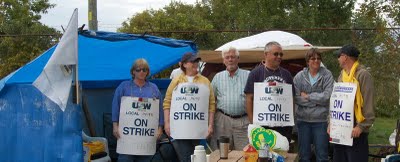 Local 14193 USWA went on strike three weeks ago, and they are still manning the picket lines with good cheer, convinced in the righteousness of their cause. The issues still outstanding after six months of bargaining are changes in language and the refusal of Cameco to assume the extra cost of funding retirees benefits the fact that a 0% in the first year and 2% in the second was offered also rubbed salt. In 2004 each and every member took a pay cut to maintain the benefits of the retirees and in this round of bargaining they asked the Company for another 15 cents to maintain the same level for the retirees. As there was no money offered in the first year the benefit funding was in deficit because there was no monetary package to take the 15 cents from. So that funding is a huge issue for the members and when the Company proposed to change the language of the Long Term Disability definitions from "own occupation" to "any occupation", it became obvious that the Company wasn't prepared to deal with the problem of injured workers the Union wasn't prepared to have to take the Insurance Carrier to court to settle a grievance, the strike loomed large. Grant McBride and Troy Bone, President and Vice-President explained the problem and also told me that support for the 137 strikers was strong in the Steelworkers, I had just missed the regional Director's visit, when I turned up at the picket line for a chat. A strike vote of over 98% put them on the picket lines. Since then donations have been coming in and the Strike Fund is strong and will probably produce an average of $300 p.w. to help defray lost wages.
 In a related story story this is one of the vans that the Security Company - Corporate Investigative Services, are using to monitor the strikers. This Company's website is here, gumshoes.com !! (Sounds like a Janet Evanovich novel, not a professional strikebreaking firm) Sitting in the van here and another one 25 yds away at least seven men and women were spotted idling their time. Just what they are supposed to be doing is a mystery but the Company has taken over a floor of the Comfort Inn in Port Hope to accomodate the multitude of security people. Grant McBride told me, "These guys have a budget of $564,000 and our benefit request will only cost $41,000 so you go figure where their (the Company) priorities are."
Wandering over to the van I asked a chap called Weber, that's what the nametag said, and asked if he would say anything about his job. "I can't say anything to you, who are you?" "Can I speak to your manager", I continued. He got on his phone and said, after a while, "All I can tell you is that I work for CSI and you will have to talk to Head Office in Lambeth for more details." "Thank you Mr Weber, you told me nothing, so I will not tell you who I am." was my reply.
Such is the life on the picket line.
This story has so many layers. Management laid off salaried 79 workers from the Cobourg plant during this strike. The Cobourg plant, up until about five years ago had steadfastly refused to join the Union. Why should they they argued, "we get all the benefits the workers in Port Hope get and don't have to pay dues!" So how did management treat these loyal company loving people? They laid them off out of seniority and arbitrarily and then blamed the Union. Funny strike tactics being employed here by management.
PS follow 14193 on Twitter - /14193

15 comments:
I wish these strikers all the best. If they win all or even a part of what their demands, good for them.
Those of us out here in the rest of the world might be forgiven for a sense that there is a significant disconnect between these unionized workers and the everyday reality of the vast majority of those in the work force. Most of us do not have a union. Most of us do not get paid even 60% of the hourly wage these folks got -- before going on strike. Most of us are envious of the conditions and job requirements they find should be changed.
So, deep-down it is difficult to give them whole-hearted support but in strikes such as these, we often hear the strikers wonder why the public is not getting behind them.
Of course, it is even less possible to give support to "the other side" in such a strike.
I have heard other working people (non-unionized, low-paid, way low on the benefits scale, etc.) say in so many words of these very strikers, "I'm just waiting until the strike withers away, the union is no longer in there and they look to hire new people for $4 an hour less than these guys because I'll apply. That's $4 an hour more than I'm getting now."
I don't endorse this thinking personally. I do think this reality, this disconnect is something unions and especially unions on strike have to address.
As you note, this is a good question: How much is the company paying for added security during the strike relative to how little it might cost to settle?
A equally good question: How much is each worker losing in lost wages while on strike, even after strike pay is added in, relative to how long it will take to recoup those amounts with the extra hourly pay & benefits after they get back to work?
good comments anonymous. there are a lot of costs to both sides and even to others who are caught in the middle.
The 79 workers who were laid off were NOT Cobourg production workers, they were managers with nothing to manage, QA people with nothing to check and engineering staff whose work was not essential enough to warrant crossing the picket line.
What a pity that non unionized workers choose to just complain about the wages and benfits of their unionized brothers and sisters, instead of emulating them by getting unions certified in their own workplaces.
We should not resent them, but join them so everyone gets paid fair wages. That makes sense to me, and meanwhile I support the Cameco workers and wish them an early success.
Grant McBride's comment in Ben's article: "These guys have a budget of $564,000 and our benefit request will only cost $41,000 so you go figure where their (the Company) priorities are."
Since we all know (don't we?) that rational decision-making in a free market always arrives at the most efficient result, we must simply accept that there is more here than meets the eye and rest assured that the best course of action is to let the market decide. Right?
... but Deb, you are not in a union. Are you in the midst of an organizing campaign?
To the last Anonymous - if I wasn't lucky enough to work for an established, Labour based and locally governed social justice organization, in a work area funded by Legal Aid Ontario, I would very likely be seeking union representation. I was an OPSEU member in 2 different past jobs and actively involved in the Local the 2nd time.
My son and partner are both union members if that redeems me at all.
I've never been a member of a union, well, other than a union of one -- myself. But then again, I've always been a rebel, dissident, declining to conform to groupism.
Wally, the ancient Greeks might say you found your " unity in diversity ". There's simply no way you don't conform to " groupism " of one sort or another.
I abide by some of the forces of groupism because the group coerces it. I decline to conform to groups, aka mobs.
Deb says "...so everyone gets paid fair wages"
Deb, please help me to get a grasp of what constitutes "fair wages". I'm assuming that you're referring to compensation for whatever work is being performed. Also some indication of how "fair" is determined would help. I've been looking for these answers for a long, long time and I sure hope you've got them because your comment leaves that impression.
Fair wages is whatever a worker says they are.
I am a bit leery of answering this question, this pattern of Manfred setting me up and then Wally knocking me down is becoming a habit with them.
But it's an interesting question so I will be optimistic that Manfred really wants to have a discussion on this topic.
Being a person with modest aspirations, I have always felt that if I could pay my bills and still afford pizza and beer on Saturday night then life was good, so I guess a fair wage is one that allows people to do that.
Us lefties talk about a "living wage" and that's what that means - enough money to raise a family with a decent standard of living. I recognise that can mean different things to different people.
For me raising kids as a single parent it meant buying real milk, not powdered; and real fruit juice, not kool-aid. For others, that can mean having the cottage and the boat and the jet ski too. I think people like that probably enjoy much more than a living wage.
I just hope they are paying their fair share of taxes.
I would add to that, a fair wage is one that reflects the level of profit the employer is making, which is where the union comes in: to make that sharing happen.
Now, who's next to respond?
Deb, please indulge me a bit on this scenario. An employer has 100 employees, half single and half married. In each half, 5 are physically impaired in one way or another. Half of the singles have dependants of one sort or another. Half of the married ones have children, the rest don't. Some have 1 child, some have as many as 7. The children are all between 1 and 15 years old. Some of the employees are married to each other and some of the singles used to be. Some live within walking distance and some live up to an hour's drive away, and some of the handicapped must use special transportation that only operates certain hours. Oddly, some of the employees are pregnant, one with triplets no less. They all plan to return to their job because they need the money. That will change the family sizes as they will when some of the kids leave home. The production generated by the business is not related to who does the work, and is relatively stable due to the steady sales numbers that are relatively constant and predictable, but will not change appreciably in the forseeable future. This means the profit before employment expense remains relatively constant as well. This could describe a somewhat typical situation for an employer.
If you were that employer, what would be the method by which you would determine a "living wage" or "fair wage" for each of these employee situations, keeping in mind that the available dollars for employment expense are constant, and what you have recently said, as well as the issue of union standardization of equal pay for equal work, regardless of the economic plight of individual employees. (Any change to one employee's wage must have an offsetting change or changes on someone else's wages, to keep the employment expense within the available amount).
If you are able to describe a "fair" solution that is fair to all, including the employer who technically is actually also an employee of the business and do it to the standards you demand of employers, I will finally understand what you mean when you say "to get fair wages for everyone". Remember, "living wage" is one that allows you to "pay my bills and still afford pizza and beer on Saturday night", and "I guess a fair wage is one that allows people to do that".
Please don't brush this off as frivolous because I am dead serious about this issue. For far too long, there has been a perception that "universal fairness" is achievable while producing growth in output and profits without missing a beat, and that business owners, in general, are expected to solve this problem by simply paying more and doing with ever less. (my whining is evident)
By the way, forget Wally - he just likes to knock things down to hear the noise it makes and see the (f*%$#&@*n) dust it stirs up.
Don't have much time right now but I do have a comment generated by Manfred's response to keep this moving along.
Remembering that I grew up in a family that owned a small business, I am not altogether ignorant of these considerations.
I don't think it is the obligation of the employer to behave like the welfare office and pay staff according to their family size, or accommodate disabilities of family members.
So a fair wage is valued according to the work being done rather than the needs of the employee. The pay should reflect the degree of difficulty of the work, the training needed to qualify to do it, and the experience of the individual performing it.
Rather it is the responsibility of the government (in my opinion) through taxation policies and social programs to attempt to address the particular special needs of families and individuals.
This is where I think the Guaranteed Annual Income program would come in, to smooth out the income disparities for the disadvantaged. But we are a long way from that, and may never get there.
Hope that helps, I really have to prepare for a family occasion today. Hope I have done your question some justice and I will come back to it again later.
Manfred wrote: forget Wally - he just likes to knock things down to hear the noise it makes and see the (f*%$#&@*n) dust it stirs up. Brilliant, Manfred!
On the matter of a "living wage": I recall that Deb, many posts ago, plumped for a GAI approach. Made sense then; makes sense now.
We'll pay for GAI via the progressive income tax. This approach (funding GAI for the bottom with taxes from the top) has the salutary effect of squashing the huge income disparity bubble. Brilliant, Deb!
Post a Comment